
Off-Gassing Booth vs. Extraction Lab: Planning Separate Process Areas
https://podtronix.com/articles/off-gassing-booth-vs-extraction-lab
The short answer
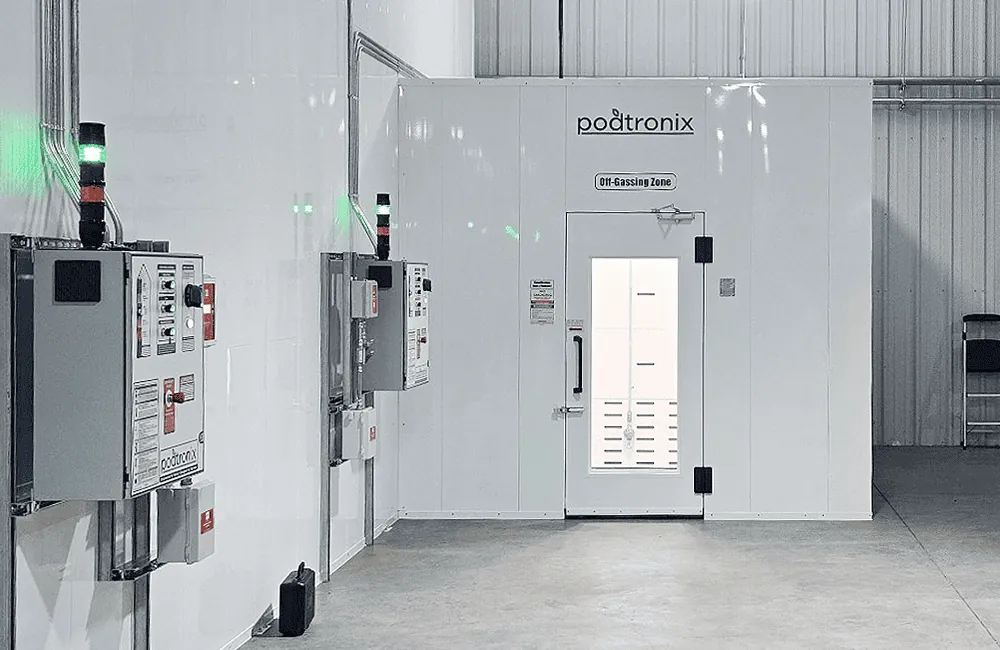
An extraction lab supports the extraction equipment and its operating process. An off-gassing booth provides a dedicated area for material that may continue releasing residual solvent after extraction. The two activities need coordinated handling and hazard review; a separate enclosure does not automatically establish a lower classification or make material safe to move.
Key takeaways
- Residual-solvent handling is a process activity that deserves its own review.
- A dedicated booth can separate workflows without automatically changing the classification.
- Material quantities, holding practices and transfer routes belong in the design brief.
- Do not set universal holding times, airflow values or release criteria from a generic article.
An extraction lab and an off-gassing booth serve related but different activities. Planning them together starts with what happens to the material after extraction, not with the assumption that residual solvent is no longer a facility concern.
What is the difference between extraction and off-gassing?
The extraction area accommodates the equipment, operators and procedures used to remove plant compounds. A dedicated off-gassing area addresses a subsequent handling stage in which material may continue to release residual solvent. Spent biomass sacks or socks from a hydrocarbon process are one example of material that can require a defined handling arrangement.
The boundary between those activities should be described in the process narrative. Identify when material leaves the equipment, how it is contained, where it moves and what happens before the next stage. Naming a space an off-gassing booth does not establish the release conditions, electrical classification or acceptable handling procedure.
Why consider a dedicated off-gassing enclosure?
A dedicated enclosure can give the activity a defined location rather than allowing it to compete with extraction equipment access and operator movement. It also creates a clearer subject for design review: what material is present, how much accumulates, who handles it and how the handling stage relates to neighboring operations.
These are planning advantages, not claims that separation alone removes the hazard. A new enclosure introduces its own access, utility and control interfaces. Review the path between areas and the consequences of doors opening, material staging and abnormal operations. The facility should be assessed as a connected workflow rather than a collection of isolated boxes.
Extraction lab focus
The equipment arrangement and operating activities used during extraction, including the interfaces defined in the process and facility design.
Off-gassing booth focus
A defined handling stage for material that may release residual solvent after extraction, with project-specific enclosure and safety requirements.
Shared planning responsibility
Coordinate material movement, area classification, electrical suitability, utilities, controls and the installation review between the two areas.
What information determines the off-gassing design brief?
Describe the material and the solvent involved. Explain the normal batch sequence, the amount handled at one time and how delayed handling could increase the quantity present. Provide the relevant safety data sheets and explain any changes in operating conditions. The design team needs the real workflow, including the unusual situations operators already know occur.
Avoid selecting a room by nominal footprint alone. Show the containers, carts or racks; the working positions; and the proposed door access. Identify whether material is transferred by hand or with equipment, how housekeeping occurs and where empty containers go. Describe these activities without assuming an arbitrary ventilation rate or a fixed safe holding period.
Off-gassing planning inputs
- Material type and residual-solvent context
- Solvent safety data and process information
- Normal and delayed batch quantities
- Containers, carts, racks and handling methods
- Proposed staging and transfer routes
- Location relative to extraction equipment
- Ventilation and control interfaces
- Operating procedures and release criteria
Does a separate booth change the hazardous-location classification?
Not automatically. OSHA's Class I definitions describe conditions involving flammable gases and vapors, and its hazardous-location rule requires individual consideration of each room, section or area. The classification depends on the activity and conditions being evaluated, not whether the enclosure has a separate door or a different name.
A proper review should also consider adjacent areas and possible communication of vapors. Ask who is responsible for the classified-area documentation and how the proposed equipment is matched to it. Do not describe the off-gassing activity as inherently non-classified or automatically suitable for a C1D2 enclosure without that review.
How should the transfer route between areas be planned?
Draw the complete route from equipment unloading to the next handling location. Mark doors, turns, changes in floor level, temporary staging and intersections with other work. Clarify whether material can accumulate outside the intended enclosure when a door is unavailable or an operator is delayed. These are practical design inputs, not simply operational details to resolve after installation.
Review the transfer sequence with the people who perform it. Establish responsibility for the written procedure, training and response to an abnormal condition through the site's safety-management process. A supplier's enclosure package should not be mistaken for a complete solvent-handling procedure or a determination that material is safe for downstream storage or disposal.
What should an existing facility review before adding a booth?
Start with current drawings and the existing process narrative. Identify the proposed booth location, equipment access, available utilities and routes for ventilation-related work. Review whether the change affects the current control arrangement, classified-area boundaries, permitting scope or other operations. Confirm the interfaces in writing with the enclosure supplier and facility professionals.
During design, decide who supplies each system and who verifies it after installation. At turnover, retain the applicable drawings, equipment instructions, classification documentation and defined functional checks. Future changes to batch quantities, solvents or handling methods should trigger another review rather than relying indefinitely on the original layout.
No universal safe-time or airflow rule
This guide does not prescribe a holding time, exhaust rate, detector threshold or release criterion. Those decisions depend on the specific process and require the responsible safety and engineering review.
Plan a dedicated off-gassing area
Explore Podtronix off-gassing booths and discuss the material, workflow and facility interfaces that need to be defined for your project.
Explore off-gassing boothsCommon questions
What is an off-gassing booth used for after extraction?
It is a dedicated enclosure for a defined material-handling activity where residual solvent may continue to be released, such as handling spent biomass from hydrocarbon extraction. Its engineered scope must reflect the actual process and material quantities.
Is an off-gassing booth automatically C1D2?
No. The classification depends on the actual release conditions and area evaluation. Moving the activity to a separate enclosure does not by itself justify a less restrictive classification.
How long should spent biomass remain in an off-gassing booth?
There is no universal safe holding time that can be given for every solvent, material and process. Establish the handling procedure and release criteria through the responsible process and safety review rather than relying on a generic time estimate.
Can an existing extraction facility add an off-gassing booth?
It may be possible, but the project must review the proposed location, transfer route, utilities, ventilation interfaces, controls and effects on the existing facility. Confirm the scope with the design professionals and local AHJ before installation.
Sources and standards references
These primary references support the regulatory explanations above. Project-specific classification, equipment suitability and permits require the responsible professional review.
- OSHA 29 CFR 1910.399 — Definitions applicable to electrical safety
Class I definitions include conditions involving flammable vapor release; classification is not established by naming a room.
- OSHA 29 CFR 1910.307 — Hazardous (classified) locations
Each room, section or area is considered individually, with documented classification and appropriate electrical installations.
- UL Solutions — Plant Oil Extraction Machines Safety Certification
Explains risks and equipment categories associated with solvent-based plant oil extraction and processing.
Continue reading
Ready to Get Started?
Connect with our engineering team to discuss your extraction, processing, or cultivation requirements. We design, manufacture, and install code-compliant classified environments across North America.